
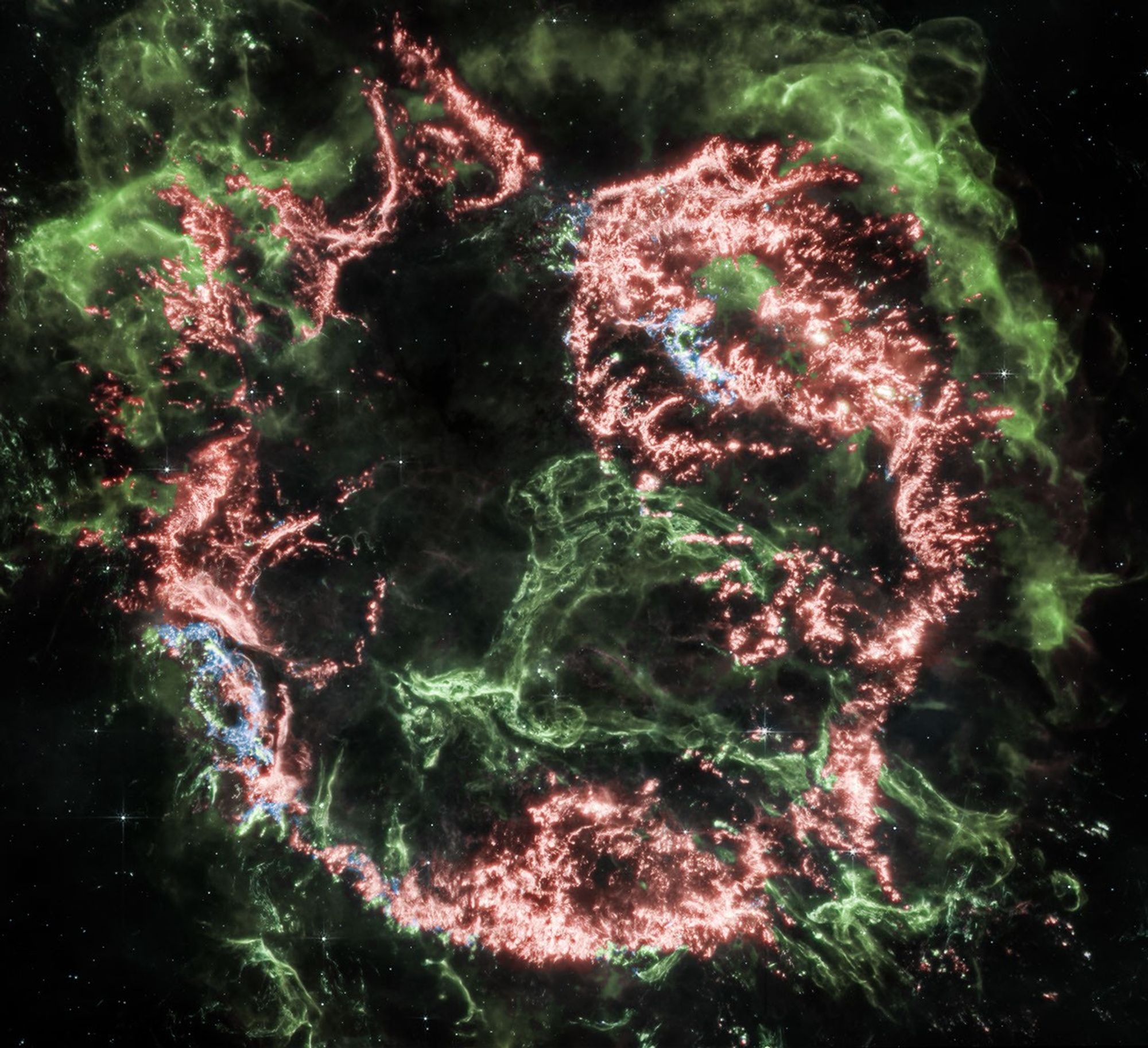
The dust of a dead star has given up the secret of its final hours. NASA's James Webb Space Telescope has mapped the dust inside Cassiopeia A, the youngest known remnant of an exploding massive star in our galaxy, and the chemistry of that dust points to a violent reshuffle inside the star shortly before it blew apart. The results were published on Monday, November 23, 2026, in The Astrophysical Journal Letters, led by Tea Temim of Columbia University.
Cassiopeia A, called Cas A, sits about 11,000 light-years away in the constellation Cassiopeia and spans roughly 10 light-years. The star that made it exploded about 340 years ago as seen from Earth, and the expanding cloud of gas and dust left behind is the closest thing astronomers have to a stellar autopsy: the debris still carries the chemical record of the star that died. Webb's Mid-Infrared Instrument, MIRI, looked at that debris with its medium-resolution spectrometer and resolved individual clumps of dust, each roughly the size of a solar system, to read what each one is made of.
The team, including Rick Arendt of the University of Maryland, Baltimore County and Dan Milisavljevic of Purdue University, studied three regions that NASA's retired Spitzer Space Telescope had picked out years earlier. Spitzer could see that different dust families lived in different parts of the remnant, but its view was too blurry to say which dust dominated each clump. Webb's sharper eye settled that. In the argon-bright ejecta hit by the reverse shock, the inward-moving shock wave now colliding with the outward debris, the dust is mostly silica, silicon dioxide. In a separate neon-bright region rich in carbon monoxide, the dust is mostly amorphous carbon. A third region, the strange loop of green light nicknamed the Green Monster, turned out to be warm magnesium silicate, the mineral forsterite.
The pattern fits a shell merger. Massive stars build themselves in layers, like an onion, with each shell burning a different fuel: hydrogen outside, then helium, carbon, neon, oxygen, and silicon toward the core. In the last stages before collapse, those layers can churn and mix, and two neighboring shells can merge into one. The dust chemistry Webb measured matches a star whose oxygen-burning and carbon-burning shells merged shortly before the explosion, scrambling the abundances that the blast then scattered. The merger signature shows up across much of the remnant, not just in one spot, and it lines up with independent evidence from X-ray observations by NASA's Chandra X-ray Observatory and the JAXA-led XRISM mission, which had already hinted that Cas A's progenitor mixed its layers late in life.
That timing is the point. The merger was underway very shortly before the supernova, possibly in the final hours of the star's life, and it changed what the explosion threw into space. Stellar models have predicted shell mergers for decades, but they have been a leading uncertainty in how massive stars end: a merger rewrites the star's structure, which changes the elements the explosion releases and how those elements enrich the next generation of stars and planets. Dust gives a way to test the idea that gas measurements alone cannot, because some elements hide inside dust grains and never show up in gas spectra. By reading the dust, Webb ties the explosion back to the makeup of the star that caused it, hundreds of years after the fact.
The Green Monster result also closes a mystery that has hung over Cas A since Webb's first MIRI image of it in April 2023. The green loop, named for the high wall at Fenway Park in Boston and pockmarked with small bubbles, looked like nothing astronomers expected, and its shape and complexity were hard to explain. The new spectra show it is not explosion debris at all. It is material the star shed before it exploded, a circumstellar shell lit up when the blast wave ran into it. The 2023 image was showing two eras of the same star at once: the wreckage of the explosion in the orange and pink filaments, and the wind the star blew off while it was still alive, glowing green in the middle.
There is a wider payoff, too. The same dust-mapping method works on supernovae too far away to resolve into clumps. Most supernovae in other galaxies appear as single points of light, and their mid-infrared glow is a blend of every dust family at once. Cas A shows how to unpick that blend: the silica feature at 21 microns marks reverse-shocked ejecta, carbon dust marks the neon-rich regions, and magnesium silicate marks pre-explosion wind. The paper's authors note the same signatures should be readable in the unresolved mid-infrared light of distant supernovae, where individual clumps can never be picked out. Astronomers studying those explosions can now read those signatures in unresolved light and work backward to the star that died, the same way this team did for Cas A.
The observations behind the result come from Webb's Cycle 1 observing program 1947, led by Milisavljevic, with the spectra taken in November 2022. Three small fields, each about 8 arcseconds across, were chosen to sample the three dust families Spitzer had found. The next step is more of the same: mapping dust composition across the rest of the remnant and applying the method to other young remnants, to find out how often massive stars rearrange themselves in their final hours, and how much that rearrangement decides what the universe is made of.
Source: NASA, "NASA's Webb Shows How Supernova Dust Chronicles Star Evolution," November 23, 2026; Temim et al., The Astrophysical Journal Letters 1012, L26, DOI 10.3847/2041-8213/aea901.
Image credit: NASA, ESA, CSA, STScI, Tea Temim (Columbia University), Rick Arendt (UMBC), Dan Milisavljevic (Purdue University); Image Processing: Joseph DePasquale (STScI)
As an Amazon Associate I earn from qualifying purchases. If you buy through an active affiliate link, StarPixels may earn a commission at no additional cost to you.