
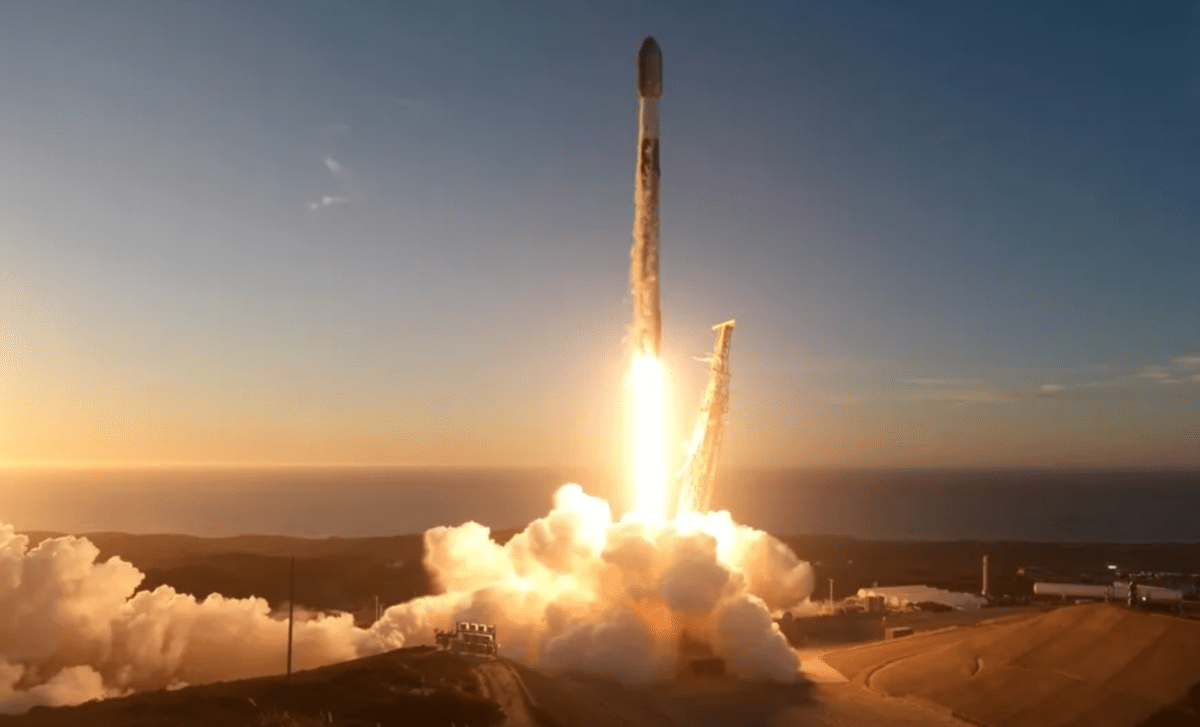
On Friday, November 6, 2026, a Falcon 9 rocket lifted off from Space Launch Complex 4E at Vandenberg Space Force Base in California, carrying a payload the United States Space Force will not describe. Liftoff came at 4:48 in the afternoon Pacific time. About eight and a half minutes later, the rocket's first stage came back down and landed on the droneship Of Course I Still Love You, stationed in the Pacific Ocean off the coast of Baja California. The mission was designated USSF-432.
Almost everything else about the flight is officially a blank. The Space Force has not said what the payload is, what orbit it went to, or what it is meant to do, and SpaceX ended its webcast shortly after the booster landed, without confirming that the satellites had deployed. That silence is standard practice for classified national-security launches. The rocket's job is public; the cargo's job is not.
What is public is the booster. The first stage that flew USSF-432 is B1095, and this was its eighth flight. It had already carried a GPS III satellite for the Space Force and a string of Starlink missions before this one, all launched from the East Coast. Landing it on a droneship after a classified launch is routine now in a way that would have sounded impossible a decade ago, and that routine is the real story of the mission: a reusable first stage, flown eight times, carrying a military payload to orbit and coming home to be flown again.
Analysts who track these launches have a working idea of what is going up. USSF-432 is also listed in public contracting documents as R-4, the fourth in a series of launches that independent analysts, including the launch tracker Jonathan McDowell, link to the Space Force's Space Based Sensing and Targeting program — a constellation of satellites meant to watch the ground and the seas from low Earth orbit. Orbital catalog entries show each earlier R launch placed 23 satellites in orbit. None of that has been confirmed by the Space Force or by SpaceX, and it should be read as the analysts' best reading of the public record, not as an official description.
The launch was also a marker of pace. It was the 702nd Falcon 9 flight overall and the 119th SpaceX launch of 2026, in a year when the company's manifest has been dominated by Starlink deployments and national-security missions in roughly equal measure. The classified missions do not get the attention the big science launches do, and they do not get the photographs either — the image here is the launch itself, a Falcon 9 climbing away from Vandenberg at sunset, the part of the mission everyone is allowed to see.
Source: Spaceflight Now, Nov 6, 2026; facts corroborated across Spaceflight Now, NASASpaceflight, Interesting Engineering
Image credit: SpaceX
As an Amazon Associate I earn from qualifying purchases. If you buy through an active affiliate link, StarPixels may earn a commission at no additional cost to you.