
Astronomers watched a planet cross its star for seven years. Then, in 2026, it stopped. The planet did not go anywhere. Its orbit tilted, and the transits that had marked it out for years simply stopped lining up with Earth. It is the first known disappearing planet, and it will not cross its star again for 30 to 50 years.
The planet is TOI-2535 b, about 1,000 light-years away. It is a hot Jupiter, a gas giant roughly the size of Jupiter that orbits extremely close to its host star, whipping around once every 8.25 days. Mercury, the fastest planet in our own Solar System, takes 88 days. TOI-2535 b was found by NASA's Transiting Exoplanet Survey Satellite, TESS, which watches for the tiny dip in a star's brightness when a planet passes in front of it. That dip only shows up if the alignment between star, planet and Earth is nearly perfect.
The discovery team, led by Samuel Yee at UCLA, watched the system from April 2019 to March 2026. At first the transits behaved strangely. They did not run on a regular schedule. They came dramatically early or late, by up to six hours, and over the years they grew shorter and shallower. Then, in 2026, they failed to appear at all. The planet was still there. It had just tilted out of view.
The culprit is a neighbour we cannot see yet. A second planet, on an orbit tilted relative to TOI-2535 b's, is pulling on it. The two planets make each other's orbits wobble like a top, and the wobble is fast enough that TOI-2535 b's transits vanished while astronomers were watching. The hidden neighbour may come into view sooner, as its own orbit wobbles into alignment, but TOI-2535 b will not transit again for decades.
The team pinned down the planet's size and heat from the transits themselves and from follow-up observations with the WIYN 3.5-metre telescope at Kitt Peak National Observatory in Arizona. Hundreds of hot Jupiters are known, but they do not usually have massive neighbours close enough to push them around. That makes this system unusual, and useful.
Hot Jupiters have puzzled astronomers since the first ones were found, because the standard picture of planet formation says gas giants need a lot of ice to form, and ice only survives far from a star. So a gas giant sitting a few days' orbit from its star must have moved there. There are two main ideas for how. In one, the planet is flung onto a stretched-out orbit by a near-collision with another object, and the star then drags it into a tight circle. In the other, the planet spirals in gently along with the other planets in its birth disc, which should leave the system flat, with no tilts between the orbits.
TOI-2535 b's wobble points the other way. The orbits in this system are tilted, which suggests the planets pushed each other around after they formed, in the same way the Moon's orbit was probably tilted by the violent collision that formed it. Because TOI-2535 b has a close neighbour, Yee thinks it probably migrated by slowly spiralling in rather than being flung in, a formation channel that may not happen often, but is very interesting to catch in the act.
The same geometry is why eclipses on Earth are rare. If the Moon's orbit lined up perfectly with Earth's orbit around the Sun, we would see an eclipse every month. It does not, so we get a few a year, and only along narrow paths. TOI-2535 b is the same story on a larger scale: a tilt of a few degrees is enough to hide a whole planet for half a century.
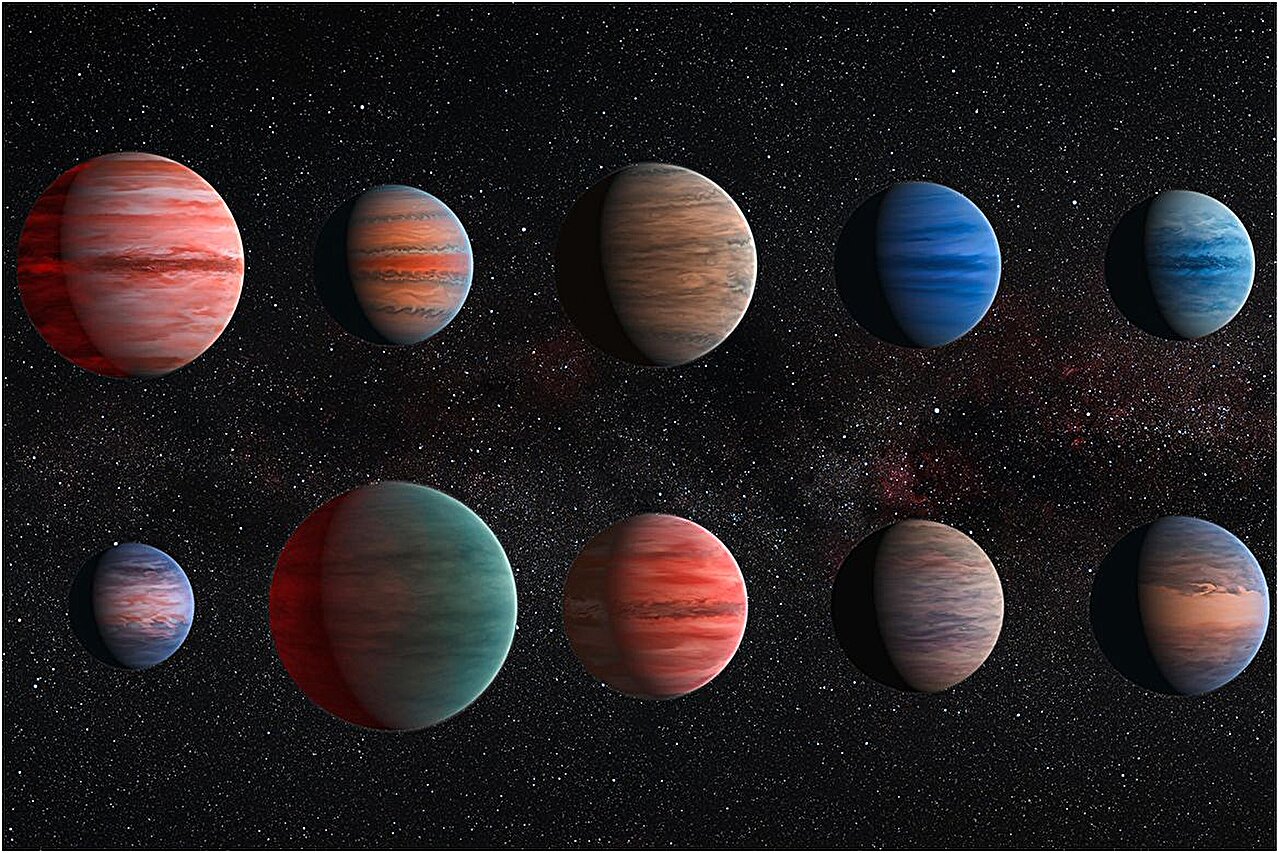
The picture above is a NASA/ESA artist's impression of ten hot Jupiters studied by the Hubble and Spitzer space telescopes, from WASP-12b to HD 209458b. It is not TOI-2535 b itself, which has never been photographed. They are the family TOI-2535 b belongs to: giants that live far too close to their stars, and are still teaching us how planets move.
Image credit: NASA/ESA (artist's impression of ten hot Jupiters studied by Hubble and Spitzer — NOT TOI-2535 b itself, which has never been photographed)
Source: phys.org Nov 9, 2026; Yee et al., ApJL 2026
As an Amazon Associate I earn from qualifying purchases. If you buy through an active affiliate link, StarPixels may earn a commission at no additional cost to you.