
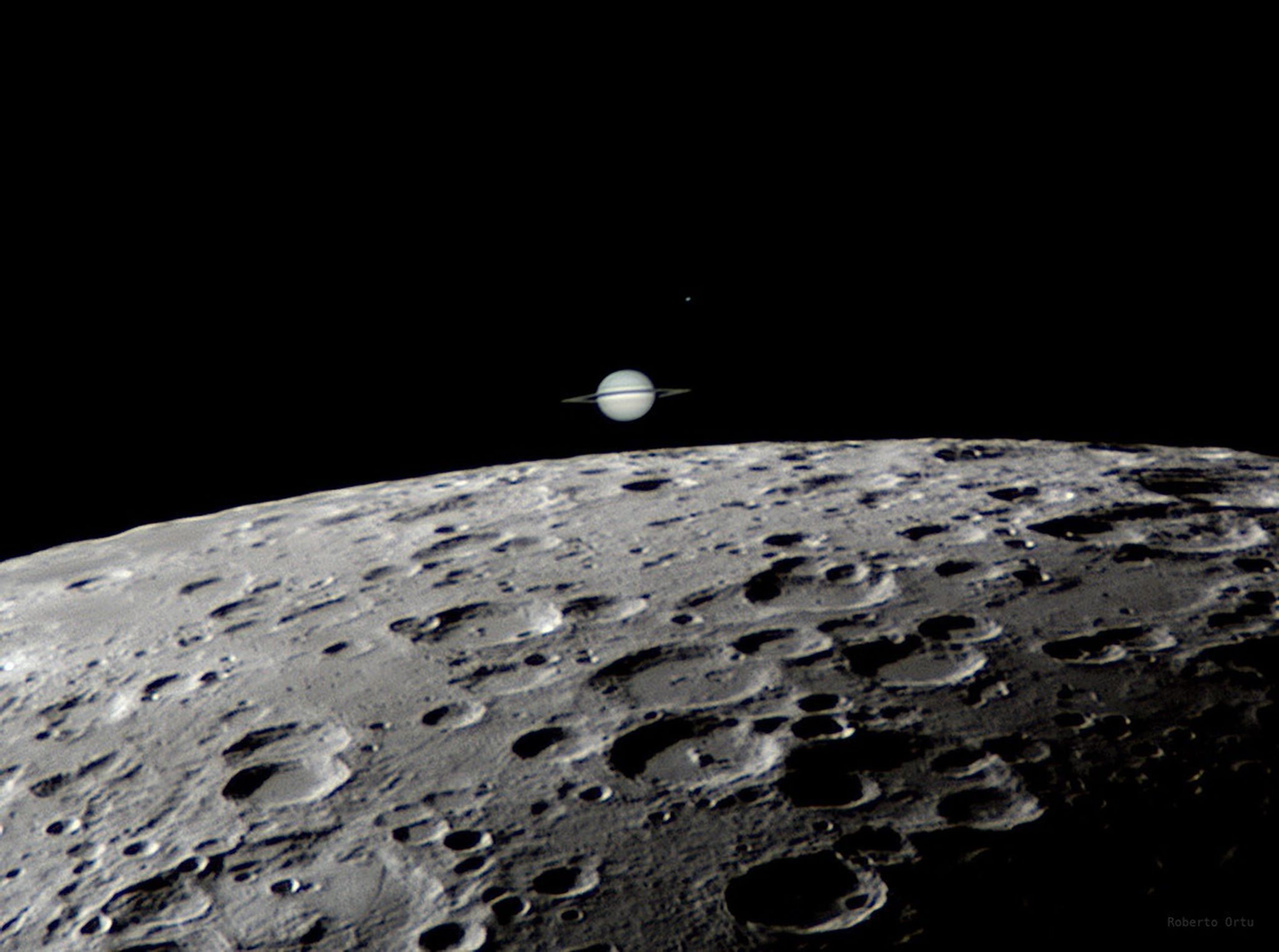
Sometimes Saturn disappears. It does not go anywhere, of course. It just slips out of view when the Moon moves in front of it, an event astronomers call an occultation. In early 2025, Saturn went behind the Moon along a narrow path across Earth, from Greenland through central Europe and into northern Africa. The picture above is from Sardinia, Italy, taken after sunset, and it is a digital fusion of three images: one of Saturn just before it disappeared, and two more of the Moon at different exposure lengths, combined so that both worlds show up clearly in a single frame.
The Moon is the only thing in the sky that can do this to a planet. It is close, about 384,000 kilometres away, and it moves against the background stars by roughly its own width every hour. Saturn is far behind it, more than a billion kilometres out, and from our point of view it is a small disc, its rings tipped almost edge-on in recent years. When the Moon's path lines up with Saturn's, the Moon simply covers it. The whole thing takes about an hour from first contact to last, and then Saturn pops back out on the other side.
What makes this picture work is the scale. The Moon's cratered surface fills the bottom half of the frame, close and detailed, while Saturn hangs small above the lunar limb, its rings a thin line across a pale disc. The bright dot near Saturn is not one of Saturn's moons. It is the star 85 Aquarii, which sits even further behind Saturn than Saturn sits behind the Moon. Three layers of depth in one photograph: the Moon in front, Saturn in the middle, and a star far behind both.
Occultations are more than a pretty sight. For centuries, astronomers timed the exact moment a star vanished behind the Moon's edge to measure the Moon's position and the shape of its limb, mountain by mountain. A planet's disappearance is slower and softer than a star's, because a planet is a disc rather than a point, and the way it fades tells you about the lunar edge it slides behind. These days the same trick is used with asteroids, where a star blinking out for a few seconds can reveal an asteroid's size and shape better than any telescope image.
The catch is that the alignment is rare and local. The Moon's shadow path for an occultation is a thin strip across Earth, and you have to be standing inside it. The early-2025 event was visible only along that Greenland-to-Africa line. Anyone outside it saw the Moon pass above or below Saturn instead. The next time the Moon moves in front of Saturn, as seen from somewhere on Earth, will be in 2031, six years of waiting for an hour of sky.
That is the other thing this picture is: a reminder that the sky runs on its own schedule. Saturn will keep circling the Sun, the Moon will keep lapping it, and every few years the two will line up again for whoever happens to be standing in the right strip of Earth. Sardinia was the right place in early 2025. In 2031 it will be somewhere else.
Image credit: Roberto Ortu (Credit & Copyright: Roberto Ortu, via NASA APOD Nov 10, 2026)
Source: NASA APOD Nov 10, 2026
As an Amazon Associate I earn from qualifying purchases. If you buy through an active affiliate link, StarPixels may earn a commission at no additional cost to you.