
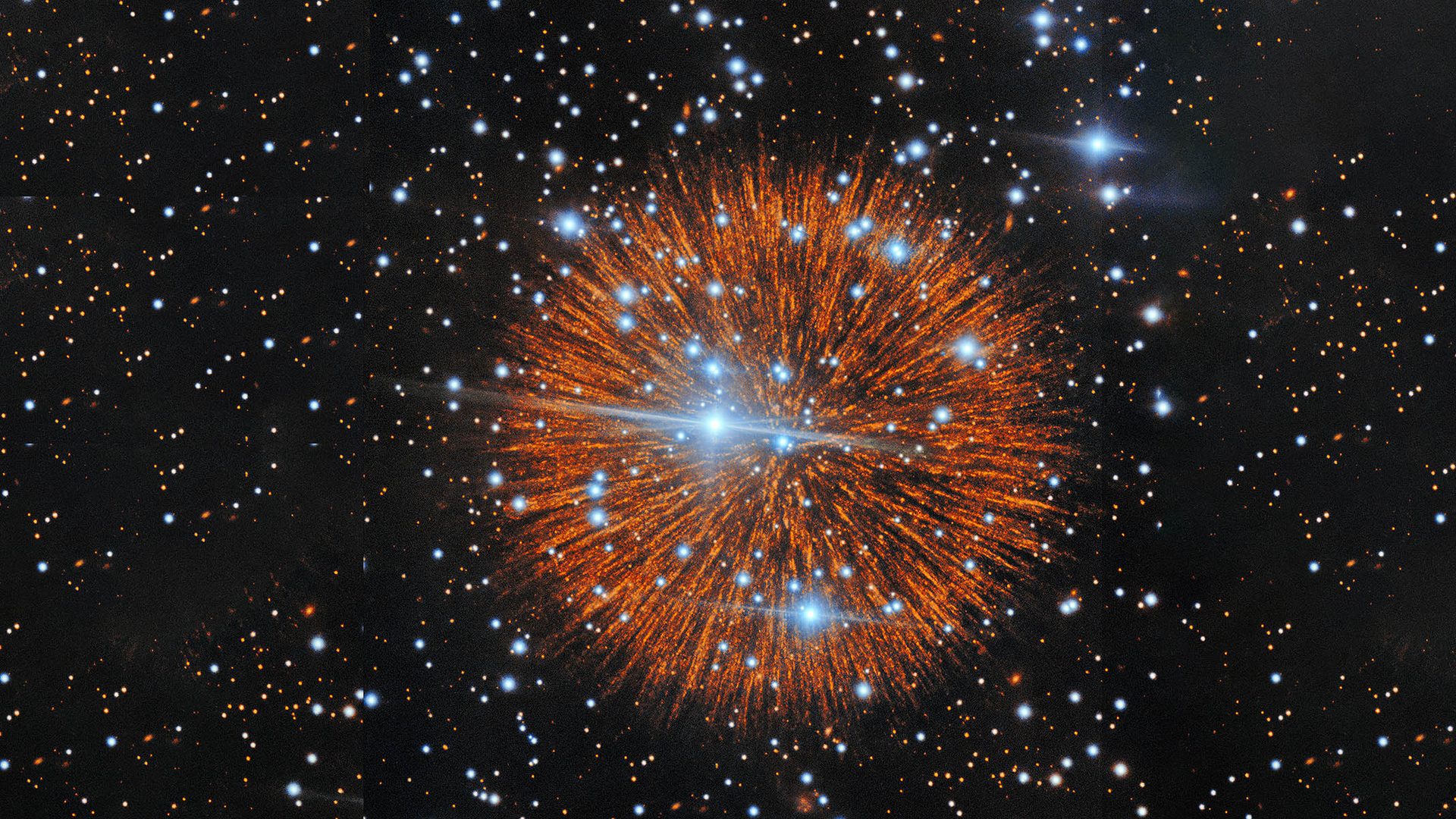
In the year 1181, skywatchers in Japan, China, and Arabia all recorded a new star in the sky — a guest star that appeared, shone for months, and then faded. For centuries, nobody knew what had happened to it. Then, in 2013, a citizen scientist found a strange, faint nebula in the constellation Cassiopeia, and astronomers matched it to the 1181 event. The nebula, catalogued as Pa 30, is the remnant of that explosion, and it is the only one of its kind known in the Milky Way.
New images from the Gemini North telescope on Maunakea in Hawai'i show Pa 30 in more detail than ever before, and the detail changes the picture. The remnant's long filaments, which used to look like smooth streaks radiating outward like a firework, turn out to be chains of knots — gas clumped into beads along a string, like pearls. The sulfur images alone revealed roughly ten times as many filamentary features as earlier pictures could resolve, and most of the streaks broke apart into strings of knots when seen up close.
The scale is hard to take in. Each knot is about 60 billion miles across — wide enough to hold the orbit of Neptune ten times over, with room to spare. The knots are also remarkably similar in size, from one streak to the next, which tells astronomers something about how the debris cooled and clumped as it flew outward. The team, co-led by Tim Cunningham and Ilaria Caiazzo of the Institute of Science and Technology Austria, made the images with the Gemini Multi-Object Spectrograph, collecting nearly seven hours of exposures in mid-2025 through filters that pass only the light of glowing sulfur and oxygen. Sulfur shows up red in the image; doubly ionized oxygen shows up blue-green.
Pa 30 is strange because its explosion was a failure — or at least, an incomplete one. Astronomers call it a Type Iax supernova, a rare kind of blast in which a white dwarf, the dense core left behind by a dead star, ignites but does not destroy itself completely. Part of the star burns and blows off into space; part of it survives. The surviving star is still there, sitting almost exactly at the center of the debris, ringed by the filaments it threw off more than 840 years ago. That is what makes Pa 30 the only known remnant of its kind: most supernova remnants are the wreckage of a star that is gone. This one still has its star.
The findings were published in The Astrophysical Journal, and they give astronomers a new test case for a kind of explosion that is still poorly understood. Type Iax supernovae are rare, and their remnants are hard to find, because the explosion is weaker than a normal supernova and the debris fades fast. Pa 30 survived long enough to be found because it is nearby and because a citizen scientist went looking. Now Gemini North has shown that its fireworks are not smooth streaks at all, but strings of enormous knots, each one bigger than our solar system, still flying outward from a star that refused to die.
Source: NSF NOIRLab, Oct 6, 2026 release; Cunningham et al., The Astrophysical Journal, DOI 10.3847/1538-4357/ae9cb2
Image credit: International Gemini Observatory/NOIRLab/NSF/AURA, T. Cunningham (Center for Astrophysics — Harvard & Smithsonian)
As an Amazon Associate I earn from qualifying purchases. If you buy through an active affiliate link, StarPixels may earn a commission at no additional cost to you.