
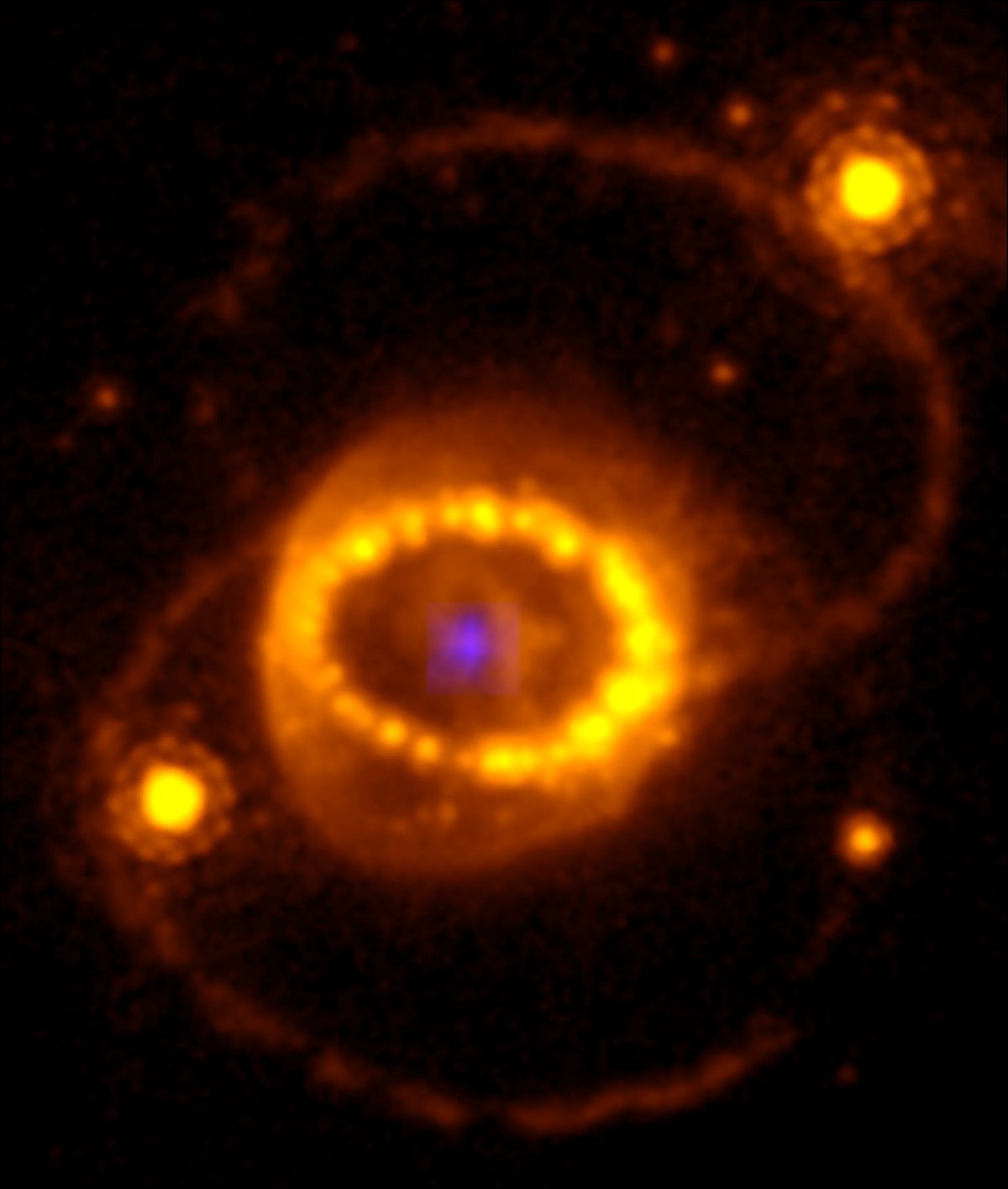
In February 1987, a star exploded in the Large Magellanic Cloud, a satellite galaxy of the Milky Way about 160,000 light-years away. For a few weeks it was bright enough to see with the naked eye from the Southern Hemisphere — the first supernova visible without a telescope since 1604. Astronomers named it SN 1987A, and it became the closest supernova of the modern age: the one event that let telescopes watch a massive star die in real time, and keep watching the wreckage for decades afterward.
Theory said the explosion should have left something behind. When a massive star's core collapses, the outer layers blast outward and the core crushes down into a neutron star, a ball of matter so dense that a teaspoon of it would weigh about a billion tons. But for nearly forty years, nobody could find the neutron star in SN 1987A. The wreckage was wrapped in dust, and the dust hid whatever was glowing at the center.
The James Webb Space Telescope finally found the evidence, using its Mid-Infrared Instrument to look into the heart of the debris. Webb detected ionized argon and sulfur near the center of the remnant — atoms stripped of electrons in a way that needs a powerful source of energy right there, at the center, lighting them up. There is no other good explanation for that glow. The finding, published in the journal Science by Claes Fransson and colleagues, is the best evidence yet that the neutron star is there, buried in the dust of its own explosion.
That matters because neutron stars are the densest matter in the universe that we can observe directly, and SN 1987A is the only case where we know the exact star that died, the exact date it died, and the exact place to look. Every other neutron star we know was found long after its supernova faded. This one has been watched from the first night, and now Webb has given us the first solid sign of the compact object at its center.
The image tells the story in one frame. The orange ring is gas the star threw off before it exploded, now lit by the shock wave from the blast. The blue and purple glow at the center is the dust and gas around the explosion site, where Webb found the ionized argon and sulfur. The remnant is still expanding, still changing, and each new telescope that looks at it sees a little more of what the explosion left behind.
This is not a new discovery being announced for the first time. The Webb result was published in February 2024, and it has been checked and built on since. It is worth coming back to because it closed one of the longest-running open questions in astronomy: the star that lit up the southern sky in 1987 did leave a neutron star behind, and we finally have the evidence to say so.
Source: NASA, Feb 22, 2024 release; Fransson et al., Science
Image credit: NASA, ESA, CSA, STScI, C. Fransson (Stockholm University), M. Matsuura (Cardiff University), M. J. Barlow (University College London), P. J. Kavanagh (Maynooth University), J. Larsson (KTH Royal Institute of Technology)
As an Amazon Associate I earn from qualifying purchases. If you buy through an active affiliate link, StarPixels may earn a commission at no additional cost to you.