
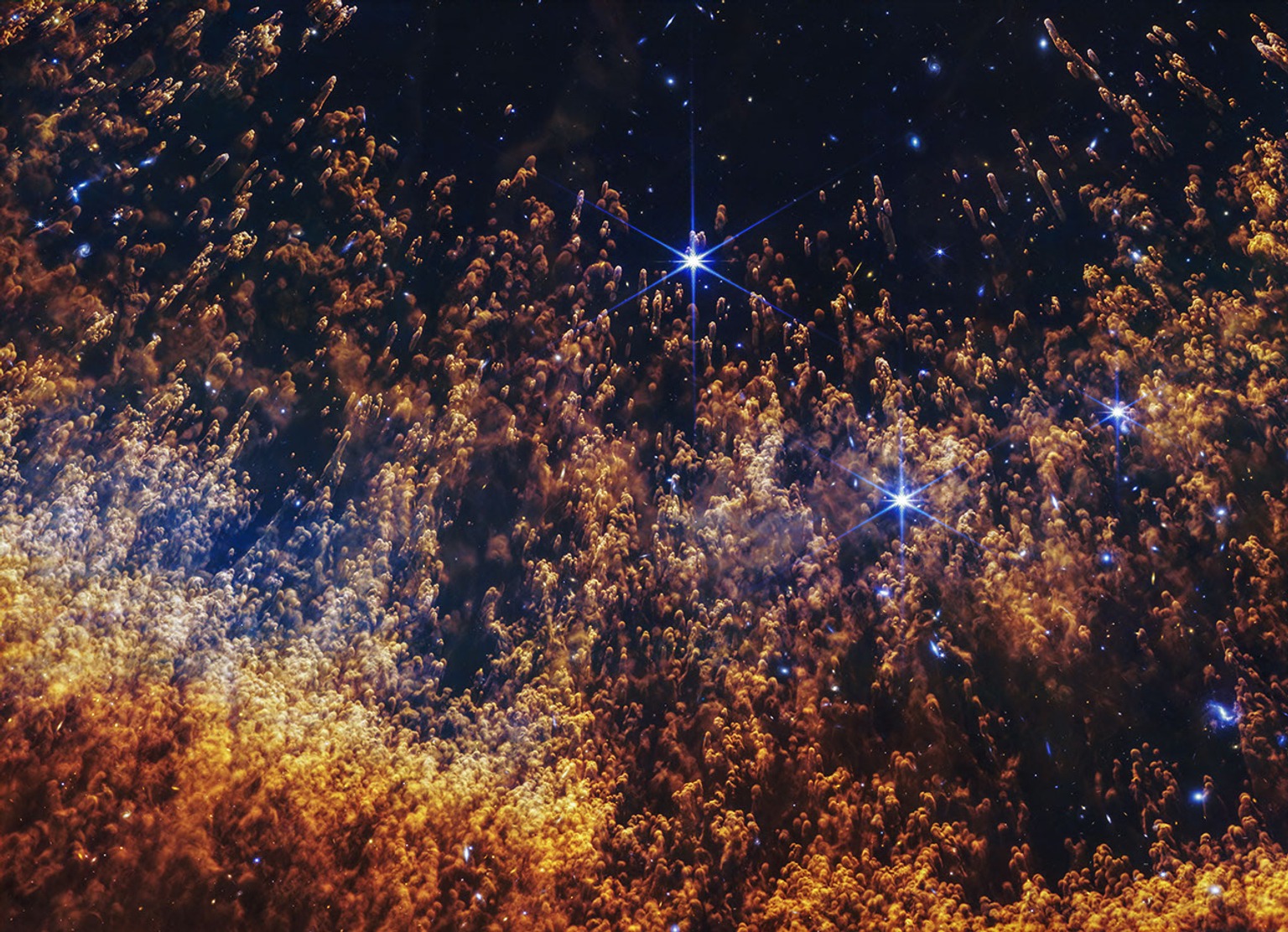
Webb has turned its sharpest infrared eye on the Helix Nebula, and the result is the most detailed look yet at the strange knots that fill the wreckage of a dying star. The new view, made with the Near-Infrared Camera aboard the James Webb Space Telescope, was released by NASA on January 20, 2026. It shows the Helix not as the smooth ring familiar from older photographs, but as a crowded field of comet-shaped knots, each one a small knot of gas with a tail streaming away from the dying star at the center.
The Helix sits about 650 light-years from Earth in the constellation Aquarius, and it is the closest bright planetary nebula to us. The name is a little misleading: there is no planet involved. A planetary nebula is what is left when a star like our Sun runs out of fuel. Near the end of its life, the star swells, sheds its outer layers into space, and leaves behind a hot, dense core called a white dwarf. The gas it threw off glows as the white dwarf's ultraviolet light strikes it, and the result is a luminous shell that can be seen across hundreds of light-years.
The knots are the part of that story that astronomers are still working out. They are clumps of gas dense enough to survive the fierce winds and radiation pouring out of the dying star. The heads of the knots face the central star and take the brunt of it; their tails stream outward, away from the heat, like the tails of comets pointed away from the Sun. Webb's infrared view cuts through the dust that hides these structures in visible light, and it shows the knots in sharper relief than any telescope has managed before, along with the faint stars that lie far behind them.
That is why the Helix matters beyond its own beauty. It is a preview of the Sun's own future. In about five billion years, our star will go through the same process: swell, shed its outer layers, and leave a white dwarf behind at the center of a glowing shell. The Earth will not survive that in any form we would recognize, but the Helix shows what the Sun's farewell will look like from the outside — a luminous cloud, threaded with knots, slowly spreading into the dark.
For observers, the Helix is one of the largest planetary nebulae in the sky, spanning about half the apparent width of the full Moon, but it is faint and spread out, so it rewards dark skies and low magnification rather than big telescopes at high power. Webb's close-up does the opposite job: it zooms into a small patch of that wide, faint cloud and shows the structure hiding inside it. The orange and gold pillars in the image are the knots themselves; the blue stars with their sharp diffraction spikes are foreground and background stars caught in the same frame. The contrast between the two is the point. The stars are points of light. The knots are the remains of a star, still glowing long after the star itself has faded to a white dwarf.
Source: NASA, Jan 20, 2026 release — https://science.nasa.gov/missions/webb/intricacies-of-helix-nebula-revealed-with-nasas-webb/
Image credit: NASA, ESA, CSA, STScI; Image Processing: Alyssa Pagan (STScI)
As an Amazon Associate I earn from qualifying purchases. If you buy through an active affiliate link, StarPixels may earn a commission at no additional cost to you.